Categories
Education and Learning

Microlearning Is Changing How People Learn — Small Lessons Are Producing Big Results

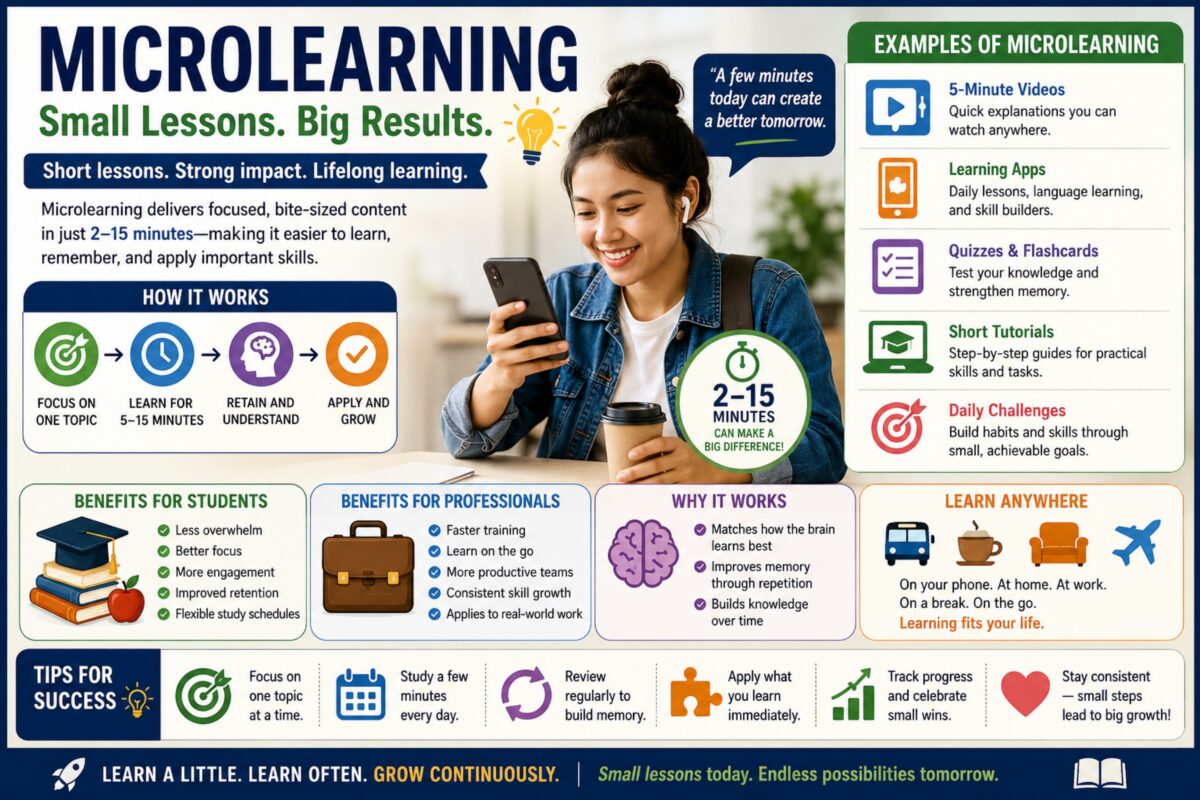
Educators, employers, training organizations, and learning platforms are increasingly adopting a strategy known as microlearning — the practice of learning information in short, focused sessions rather than long lectures or study periods.

Instead of spending hours trying to absorb large amounts of information at once, learners consume small lessons that typically take between 2 and 15 minutes to complete. These lessons often focus on a single skill, concept, or objective before moving to the next topic.

As attention spans compete with notifications, busy schedules, and information overload, many experts believe microlearning better matches how modern people consume and retain information.

📚 Why This Matters Now

The amount of information available today is growing at an unprecedented rate.

People are constantly learning:

* New technology
* Workplace skills
* Industry certifications
* Personal finance
* Health information
* AI tools
* Software updates
* Professional development

Traditional learning methods often require large time commitments that many people struggle to maintain.

Microlearning offers a practical alternative by making education more accessible and manageable.

🧠 How the Brain Benefits

Research suggests that smaller learning sessions may help improve:

* Information retention
* Focus and concentration
* Long-term memory formation
* Learning consistency
* Engagement and motivation

When information is broken into smaller segments, the brain often processes and stores it more effectively than during long periods of passive consumption.

This approach is sometimes paired with spaced repetition, where concepts are revisited over time to strengthen memory.

💻 Examples of Microlearning

Microlearning can include:

* A 5-minute instructional video
* A daily language lesson
* A short quiz
* A single tutorial
* Flash cards
* Interactive exercises
* Skill-building challenges
* Daily learning apps

Many successful learners now dedicate just a few minutes per day to continuous education rather than relying solely on lengthy study sessions.

🎯 Benefits for Students

Students may experience:

* Reduced overwhelm
* Better concentration
* Increased engagement
* Improved retention
* More flexible study schedules

Shorter learning sessions can be easier to fit around school, work, extracurricular activities, and family responsibilities.

👨‍💼 Benefits for Professionals

Organizations are increasingly using microlearning for:

* Employee training
* Safety programs
* Compliance education
* Leadership development
* Software onboarding
* Customer service improvement

Employees can learn critical skills without spending hours away from their primary responsibilities.

📱 Technology Is Driving the Trend

Smartphones, tablets, and online learning platforms have made education available almost anywhere.

People now learn while:

* Commuting
* Waiting in line
* Taking breaks
* Traveling
* Exercising
* Between meetings

Learning is becoming less about where you are and more about consistency.

🚀 Practical Learning Tips

If you’re trying to learn something new:

* Focus on one topic at a time.
* Study for 5–15 minutes daily.
* Review information regularly.
* Apply what you learn immediately.
* Track progress over time.
* Prioritize consistency over intensity.

Small daily efforts often outperform occasional marathon study sessions.

🌎 Community Impact

Accessible education helps strengthen communities by improving workforce skills, increasing digital literacy, encouraging lifelong learning, and creating more opportunities for personal and professional growth.

As educational tools become more widely available, microlearning may help bridge gaps for people who previously lacked time, resources, or access to traditional learning environments.

🔍 Learning Takeaway

You don’t have to study for hours to make meaningful progress.

A few focused minutes every day can compound into significant knowledge and skill over time.

📚 Learn a little. Learn often. Grow continuously. 🧠💡🚀
Categories
Education and Learning

Dying of Laughter

Ever heard the phrase “dying of laughter”?

Turns out, it’s not just a figure of speech.

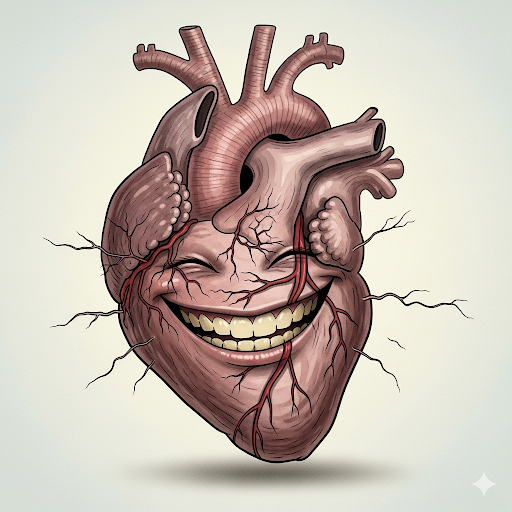
While incredibly rare, people have actually passed away from a severe laughing fit. But here’s the grim little twist it wasn’t the joy that got them. The culprit was the extreme physical stress laughter puts on the body, which can lead to a few serious problems. We’re talking about things like asphyxiation (basically, you can’t breathe), fainting from a sudden drop in blood pressure, or for people with heart issues, the strain can even trigger a cardiac arrest. So, while your favorite comedian probably isn’t a life-threatening risk, it’s a wild reminder that even our most joyful emotions can push our bodies to the absolute limit.

Categories
Education and Learning

Lobes 👂

You’ve ever looked in the mirror and wondered, “What’s the point of earlobes? They seem to be just… there. It’s a great question because, from a purely biological standpoint, they don’t seem to have a job. Unlike the rest of your ear which is shaped to funnel sound, earlobes are just soft, fleshy tissue. They don’t help you hear, balance, or even keep you warm. They’re basically a head-scratcher for biologists.

So, if they don’t have a biological purpose, what’s their point? Well, their purpose has evolved. Instead of serving a function for survival, they’ve become a canvas for human expression. Think about it earlobes are the perfect place for jewelry. People across cultures and history have adorned them with everything from simple studs to intricate, stretched gauges. This makes them a unique identifier, a symbol of beauty, or a marker of tradition. In a world where so many of our body parts are designed for a specific task, the earlobe is a quiet reminder that sometimes, the “point” of a feature isn’t about what it does for the body, but what we decide to do with it.

Categories
Education and Learning

Earth’s Speed

Earth’s rotation is not perfectly constant it’s a dynamic process that’s always changing. While the long-term trend has been a gradual slowdown, primarily due to the gravitational pull of the Moon, recent years have shown a surprising and unprecedented acceleration. This temporary speed-up is thought to be caused by a complex mix of factors, including the movement of our planet’s molten core, atmospheric and oceanic currents, and even the melting of ice sheets. These tiny fluctuations are measured by atomic clocks and are significant enough to impact global timekeeping, raising the possibility of a “negative leap second” to keep our clocks in sync with Earth’s changing spin.

Categories
Education and Learning

The Flower That Broke the Bank!

Forget gold! In 17th-century Holland, a single tulip bulb could buy you a fancy new house. This isn’t a fairy tale; it’s the insane, true story of Tulip Mania the craziest market bubble in history! Tulips weren’t native to Holland, they were exotic superstars from the Ottoman Empire. Once these vibrant flowers hit Europe, they became an instant obsession, the “it” item for the wealthy elite. Owning them was a sign you had made it! The real madness began with a non-lethal virus that created stunning, multi-colored “flames” on the petals. These “broken” tulips were ultra-rare, one-of-a-kind masterpieces. The rich had to have them, no matter the cost! The market went completely nuts. At the peak, a single Viceroy tulip bulb was traded for a horse, a pig, a bed, and thousands of pounds of cheese the total value of a new house! Some bulbs sold for more than 10 times a skilled craftsman’s yearly salary! It wasn’t about flowers anymore it was pure, wild speculation! Then… it all fell apart. One buyer didn’t show up for a sale, and the entire house of cards collapsed. Panic! Everyone tried to sell at once, but no one was buying. Fortunes vanished overnight! The lesson is clear: when the hype is more valuable than the product, you’re in for a crash!

Categories
Education and Learning

Developing A Growth Mindset

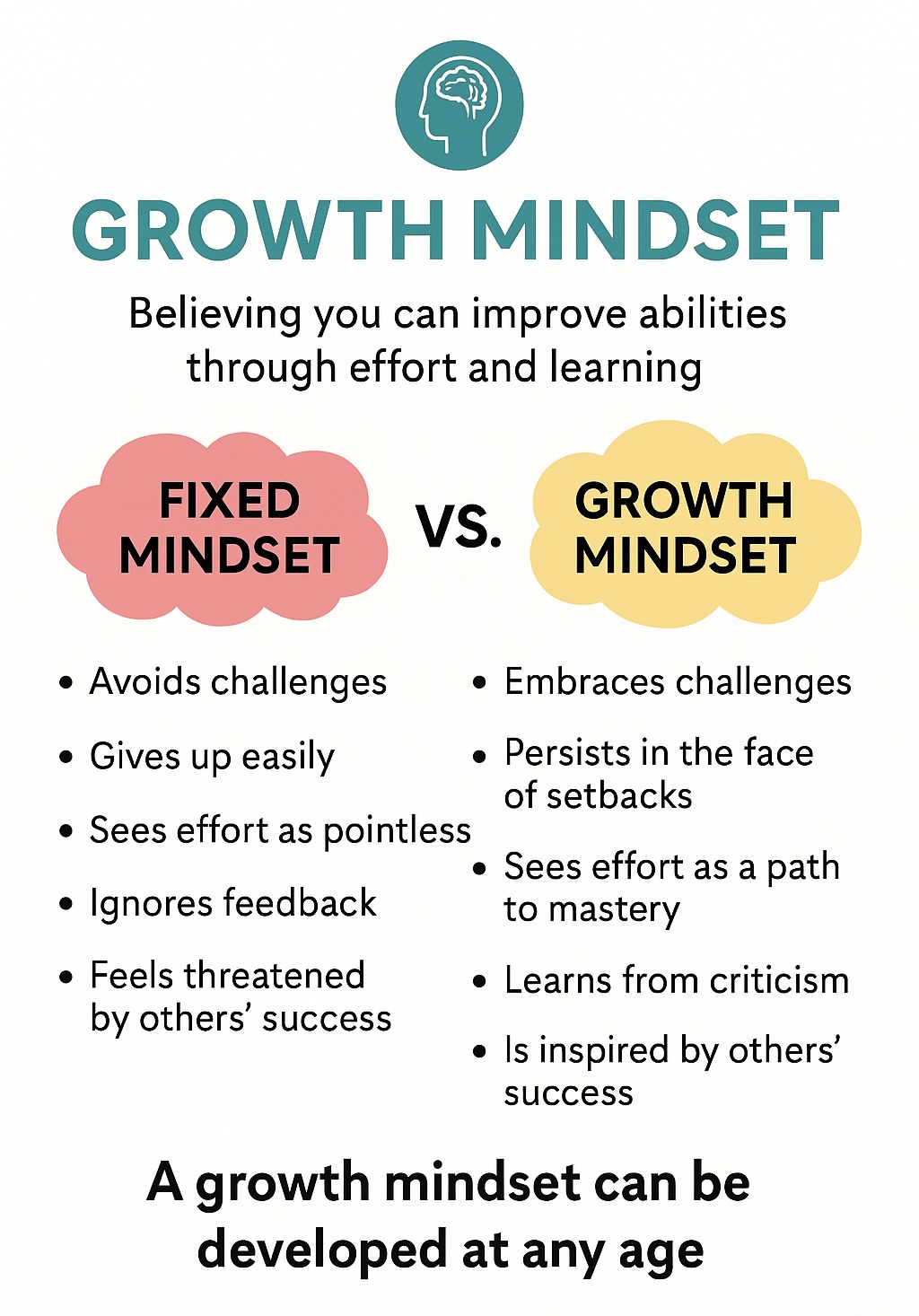
Developing a growth mindset the belief that abilities and intelligence can be improved through effort, learning, and persistence benefits learners of all ages. Embracing challenges, learning from mistakes, and seeking feedback not only improve academic performance but also build resilience and problem-solving skills that last a lifetime.

Categories
Education and Learning

Megatall Skyscraper

The tallest building in the world is the Burj Khalifa, located in Dubai, United Arab Emirates.

It has held this title since its completion in 2010 and stands at an impressive height of 828 meters (2,717 feet).

Categories
Education and Learning

The World’s Quietest Place Is So Quiet, You Can Hear Your Own Blood Flow.

Have you ever wondered what the quietest place on Earth is?

It’s not a remote desert or a silent mountaintop. It’s an anechoic chamber at Microsoft’s headquarters in Redmond, Washington.

This room is so quiet that it holds the Guinness World Record for the quietest place on Earth. The ambient noise level is a stunning -20.35 decibels.

To put that in perspective, a quiet library is around 30 decibels, and a whisper is about 15-20 decibels. The threshold of human hearing is 0 decibels.

Spending time in this chamber is a truly surreal experience!

After just a few minutes, your ears will start to adapt to the silence, and you’ll begin to hear sounds you’ve never noticed before. You can hear your own heartbeat, a ringing in your ears, and even the sound of your own blood flowing. The lack of external noise is so disorienting that people have reported feeling dizzy or struggling to stand upright inside the room.

Categories
Education and Learning

Most lipstick contains fish scales.

Most of the lipsticks made are the byproduct of fish scales called pearl essence or pearlessence as it turns out that the stuff that makes the fish scales shine makes one’s lips shiny as well. Pearlessence comes from commercially fished herring. There are synthetic versions available as well but they are not widely used.

Categories
Education and Learning

💡Illuminating Light

Light is a form of electromagnetic radiation visible to the human eye, traveling in waves at approximately 299,792 kilometers per second (186,282 miles per second) in a vacuum. It exhibits dual properties, behaving as both a wave and a particle (photon), which is fundamental to quantum mechanics. Light can be reflected, refracted, absorbed, or scattered depending on the medium it interacts with. The visible spectrum of light ranges from violet to red, each color corresponding to a specific wavelength, while ultraviolet and infrared light fall outside human vision. Understanding light has led to major scientific advancements, including the development of optics, lasers, fiber-optic communications, and modern imaging technologies.