
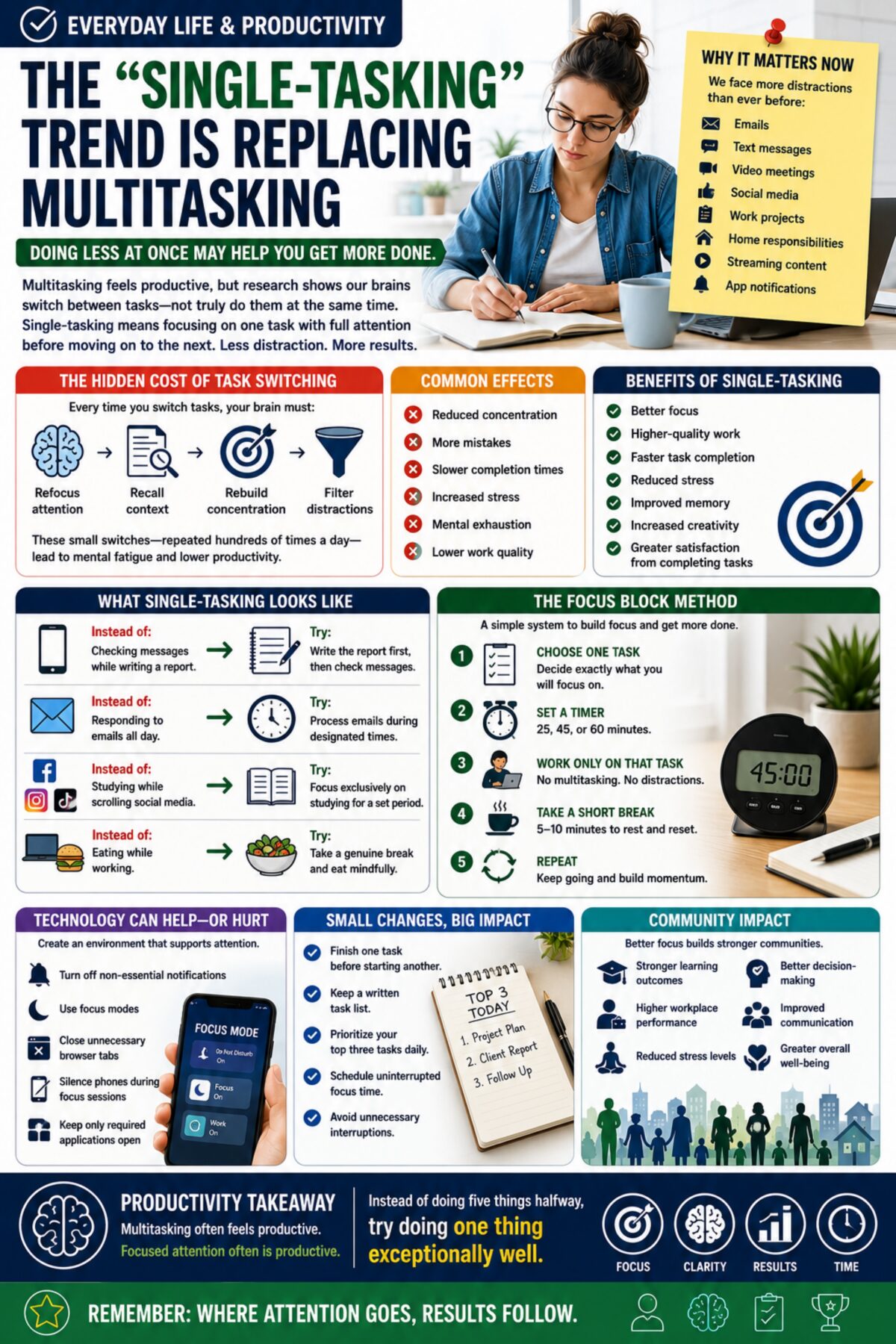
For years, multitasking was often viewed as a valuable productivity skill. Many people prided themselves on answering emails during meetings, checking messages while working, watching videos while studying, or juggling multiple projects simultaneously.
Today, productivity researchers and workplace experts are increasingly promoting a different approach:
Single-Tasking.
Single-tasking means focusing on one task at a time with full attention before moving on to the next activity.
While multitasking feels productive, studies suggest that the brain doesn’t truly perform multiple complex tasks simultaneously. Instead, it rapidly switches between them. Each switch requires mental energy, reducing efficiency and increasing the likelihood of mistakes.
As distractions continue to grow through smartphones, notifications, social media, messaging platforms, and constant connectivity, many people are discovering that focusing on one thing at a time may actually help them accomplish more.
🧠 Why This Matters Now
Modern workers and students face unprecedented levels of distraction.
Many people regularly juggle:
* Emails
* Text messages
* Video meetings
* Social media
* Work projects
* Household responsibilities
* Streaming content
* App notifications
Because attention is constantly divided, many individuals report feeling busy all day while struggling to make meaningful progress.
⚠️ The Hidden Cost of Task Switching
Every time you switch tasks, your brain must:
* Refocus attention
* Recall context
* Rebuild concentration
* Filter distractions
These transitions may only take seconds, but repeated hundreds of times per day, they create significant mental fatigue.
Common effects include:
* Reduced concentration
* More mistakes
* Slower completion times
* Increased stress
* Mental exhaustion
* Lower work quality
🎯 What Single-Tasking Looks Like
Instead of:
📱 Checking messages while writing a report
Try:
📝 Writing the report first, then checking messages afterward.
Instead of:
📧 Responding to emails all day
Try:
⏰ Processing emails during designated times.
Instead of:
📚 Studying while scrolling social media
Try:
🎓 Focusing exclusively on studying for a set period.
Instead of:
🍽️ Eating while working
Try:
🥗 Taking a genuine break and eating mindfully.
🚀 Benefits of Single-Tasking
Many people report:
✔ Better focus
✔ Higher-quality work
✔ Faster task completion
✔ Reduced stress
✔ Improved memory
✔ Increased creativity
✔ Greater satisfaction from completing tasks
⏱️ The Focus Block Method
One popular approach involves:
Step 1
Choose one task.
Step 2
Set a timer for:
* 25 minutes
* 45 minutes
* 60 minutes
Step 3
Work only on that task.
Step 4
Take a short break.
Step 5
Repeat.
This structured approach helps build concentration while reducing burnout.
📱 Technology Can Help—or Hurt
Productivity experts often recommend:
* Turning off non-essential notifications
* Using focus modes
* Closing unnecessary browser tabs
* Silencing phones during focus sessions
* Keeping only required applications open
Creating an environment that supports attention often produces immediate improvements.
🧩 Small Changes That Make a Big Difference
Try:
* Finishing one task before starting another.
* Keeping a written task list.
* Prioritizing your top three tasks daily.
* Scheduling uninterrupted focus time.
* Avoiding unnecessary interruptions.
Even small reductions in task switching can improve productivity.
🌎 Community Impact
Improved focus benefits more than individual productivity.
Better concentration can contribute to:
* Stronger learning outcomes
* Higher workplace performance
* Reduced stress levels
* Better decision-making
* Improved communication
* Greater overall well-being
As distractions continue increasing, attention is becoming one of the most valuable personal resources people possess.
🔍 Productivity Takeaway
Multitasking often feels productive.
Focused attention often is productive.
Instead of doing five things halfway, try doing one thing exceptionally well.
Remember:
Where attention goes, results follow.
🎯🧠📈⏱️ One task. Full focus. Better results.