
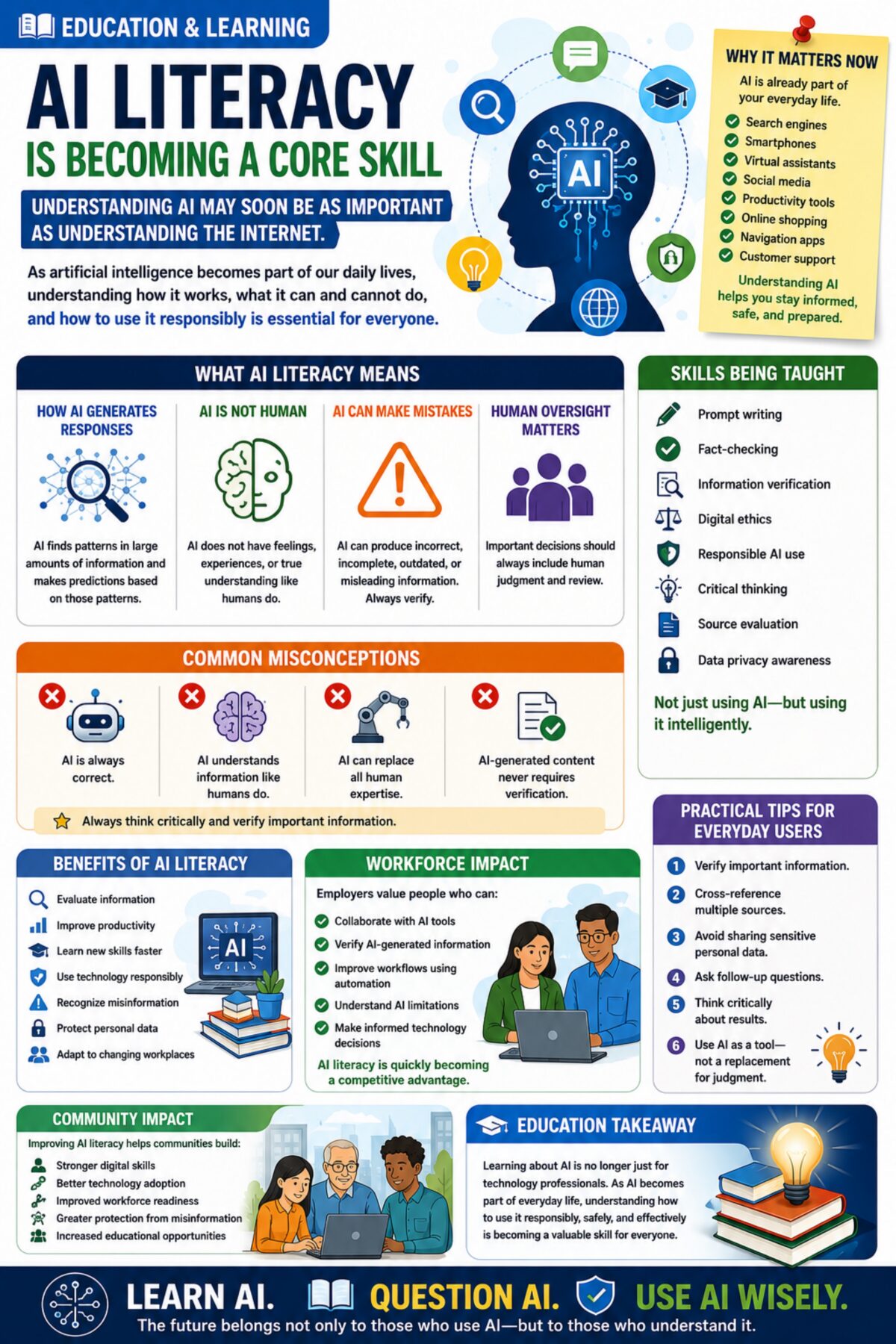
Schools, universities, employers, and workforce development organizations are increasingly emphasizing a new form of digital literacy:
AI Literacy.
As artificial intelligence becomes integrated into search engines, productivity software, customer service platforms, healthcare systems, education tools, financial services, and everyday devices, experts believe understanding how AI works is becoming an essential life skill.
AI literacy does not require learning computer programming or becoming a software engineer. Instead, it focuses on helping people understand what AI can do, what it cannot do, how to evaluate AI-generated information, and how to use these tools responsibly and effectively.
Much like internet literacy became critical during the rise of the digital age, AI literacy is quickly becoming an important part of education and lifelong learning.
🤖 Why This Matters Now
Artificial intelligence is appearing almost everywhere.
People encounter AI when using:
* Search engines
* Smartphones
* Virtual assistants
* Navigation apps
* Customer service chatbots
* Social media platforms
* Productivity software
* Content creation tools
* Translation services
* Online shopping recommendations
Many individuals use AI daily without realizing it.
As adoption continues to grow, understanding the technology becomes increasingly important.
📚 What AI Literacy Means
AI literacy includes understanding:
How AI Generates Responses
AI identifies patterns from large amounts of information and generates predictions based on those patterns.
AI Is Not Human
AI can produce impressive results, but it does not possess human judgment, emotions, experiences, or true understanding.
AI Can Make Mistakes
AI systems sometimes generate inaccurate, incomplete, outdated, or misleading information.
Verification remains essential.
Human Oversight Matters
Critical decisions should involve human review and judgment.
🧠 Skills Being Taught
Educational programs are increasingly teaching:
* Prompt writing
* Fact-checking
* Information verification
* Digital ethics
* Responsible AI use
* Critical thinking
* Source evaluation
* Data privacy awareness
The goal is not simply using AI, but using it intelligently.
⚠️ Common Misconceptions
Many people incorrectly assume:
* AI is always correct.
* AI understands information like humans do.
* AI can replace all human expertise.
* AI-generated content never requires verification.
Experts strongly recommend maintaining critical thinking when using any AI-powered system.
🎓 Benefits of AI Literacy
People who understand AI may be better equipped to:
✔ Evaluate information
✔ Improve productivity
✔ Learn new skills faster
✔ Use technology responsibly
✔ Recognize misinformation
✔ Protect personal data
✔ Adapt to changing workplaces
💼 Workforce Impact
Employers increasingly value workers who can:
* Collaborate with AI tools
* Verify AI-generated information
* Improve workflows using automation
* Understand AI limitations
* Make informed technology decisions
Many industries now view AI literacy as a competitive advantage.
📱 Practical Tips for Everyday Users
When using AI:
1. Verify important information.
2. Cross-reference multiple sources.
3. Avoid sharing sensitive personal data.
4. Ask follow-up questions.
5. Think critically about results.
6. Use AI as a tool—not as a replacement for judgment.
🌎 Community Impact
Communities that improve AI literacy may benefit from:
* Stronger digital skills
* Better technology adoption
* Improved workforce readiness
* Greater protection from misinformation
* Increased educational opportunities
The ability to understand emerging technologies helps individuals participate more effectively in modern society.
🔍 Education Takeaway
Learning about AI is no longer just for technology professionals.
As AI becomes woven into everyday life, understanding how to use it responsibly, safely, and effectively is becoming a valuable skill for everyone.
Remember:
The future belongs not only to those who use AI—but to those who understand it.
🤖📚💡🌎 Learn AI. Question AI. Use AI wisely.